Sunday, April 8, 2012

After After Theory

Jennifer Popa
Dr. Heyne
ENGL 601
4.7.12

After Theory

One thing that I found interesting as an ongoing discussion is the melding of high theory and the low-brow analysis of say “Jersey Shore.” That’s something that I’ve found to be a surprise in grad school, the freedom to incorporate canonical pieces of literature or theory with pop culture. It’s certainly something I enjoyed in Jen Schell’s class last semester, and it brought relevance to century old texts so that they could be evaluated in a more contemporary light (ie Pamela as perhaps the Twilight of another generation). One glaring issue in academia is that we devote entire semesters to thinking about texts, to ruminating, to engaging in cyclical dialogs about the abstract, but that seems to be where things end. The act itself can feel a bit pompous and even narcissistic at times, but then again we are a room full of writers so I suppose that’s to be expected. Hah! Eagleton points out the separation from the experiences of ordinary people, and that academics are the ones who speak for them. That seems like a rather daunting task.

I enjoyed the first chapter’s tour of theory, and found the reading witty and light given the dense subject matter. There were times though that the text felt a bit like sour grapes to me. Maybe this is just my reading, but Eagleton seems somewhat bitter at times. Capitalism reigns supreme and is the prettiest girl at the dance, and Marxism, though fundamental to theory seems to have become a bit of a wallflower. After Theory has a very specific audience in mind, more specifically the left. So in a way it feels like an act of preaching to the converted. Maybe this is just a sign that I’ve engaged in the masochistic act of watching Fox News, and know that Marx and socialism are dirty filthy words. And somehow Glenn Beck always seems to tie them back to him becoming a white slave? Oh Glenn!


Still, I felt a bit confused at what exactly Eagleton was suggesting as a solution to this after theory quandary we find ourselves in, because the solution of a breather from capitalism doesn’t seem to solve it for me. He turns to philosophy, specifically Aristotle, but I’m not sure how exactly this forges new territory. What does post-postmodernism look like? There’s great discussion of virtue, evil, truth, objectivity, but I’m unsure about how one gets back to their “human essence” and what precisely that looks like. How do we account for disparity between different culture’s ideas of human essence? I appreciated the book but it seems to have scratched the surface, and I’m not entirely sure what my take away is as the reader. What solution is Eagleton suggesting, aside from getting back to the roots of philosophy or socialism?

Saturday, April 7, 2012

Response to Eagleton


Caitlin Scarano
ENGL 601
Heyne
7 April 2012

Reading Response 4: After Theory

In After Theory, Terry Eagleton takes issue with modern cultural theory – that it is not politically relevant and active enough.  This text, I believe, addresses the gap between theory and practice. Here, Eagleton describes the envisioning potential of theory, how theory can create more livable lives, as Judith Butler might say, “We need to imagine new forms of belonging, which in our kind of world are bound to be multiple rather than monolithic.  Some of these forms will have something of the intimacy of tribal or community relations, while others will be more abstract, mediated and indirect.  There is no single ideal size of society to belong to, no Cinderella’s slipper of a space.  The ideal size of community used to be known as a nation-state, but even some nationalists no longer see this as the only desirable terrain” (Eagleton 21).
This envisioning potential and the “intimacy of tribal or community relations” made me think of a passage from Ernest Callenbach’s Ecotopia – a text I would highly recommend.  The following is a description of the communities in the fictional country of Ecotopia (comprised of Washington, Oregon, and Northern California when they secede from the United States in an attempt to live more sustainably):  “Around the factory, where we would have a huge parking lot, Alviso [the town] has a cluttered collection of buildings, with trees everywhere. There are restaurants, a library, bakeries, a ‘core store’ selling groceries and clothes, small shops, even factories and workshops – all jumbled amid apartment buildings. These are generally of three or four stories, arranged around a central courtyard […] They are built almost entirely of wood, which has become the predominant building material in Ecotopia, due to the reforestation program. […] The apartments themselves are very large by our standards – with 10 or 15 rooms, to accommodate their communal living groups” (Callenbach 26).
Callenbach had a theory of how we could live more holistically (with little to no negative impact on the environment) and enacted this vision through the mode of literature.  A question I might have for Eagleton – does theory have more or less transformative, envisioning, or political potential than the art it considers?  Either way, theory, like literature, should be proactive in creating solutions to issues of the human condition and capitalism, not disconnected from the process.
Nowadays, we have a shallow, materialistic understanding of culture (for example, pop-culture), and a focus on the deviant nature of culture, not the political questions at hand, but once culture functioned as “a critique of middle-class society, not as an ally of it.  Culture was about values rather than prices, the moral rather than the material, the high-minded rather than the philistine” (Eagleton 24).  I found the following passage interesting in regards to the connection between marginality, liminal space, and the creation of art:  “To be inside and outside a position at the same time – to occupy a territory while loitering skeptically on the boundary – is often where the most intensely creative ideas stem from” (Eagleton 40). Also, the use of the word occupy in the quote brought the Occupy Movement to my mind.  I wonder if Eagleton would view the Occupy Movement as a good example of political theory in action, especially in an anti-capitalist sense. 
“The inescapable conclusion is that cultural theory must start thinking ambitiously once again – not so that it can hand the West its legitimation, but so that it can seek to make sense of the grand narratives in which it is now embroiled” (Eagleton 73).  I think that theory should be radical, visionary, challenging, and tangible. Tangible here means not separate from practice, or even bridged to practice, but within practice, part of an interlocking system.  We think in terms these theories and automatically live out those terms.  For example, the essay I am writing for our class is not just an academic exercise that begins and ends in itself (get the grade, done), but meaningful to me because the concept (or theory) of the queer-uncanny makes an applicable, real-world criticism and has transformative potential in how the LGBT community is treated and how they live.
Eagleton clearly takes issue with capitalism, but what exactly are his proposed solutions?  For example, not the vagueness here: “By encouraging us to dream beyond the present, it may also provide the existing social order with a convenient safety-valve.  Imagining a more just future may confiscate some of the energies necessary to achieve it” (Eagleton 100).  Eagleton does appear to be a proponent of socialism as a theory in practice solution:  “One reason for judging socialism to be superior to liberalism is the belief that human beings are political animals not only in the sense that they have to take account of each other’s need for fulfillment, but that in fact they achieve their deepest fulfillment only in terms of each other” (Eagleton 122).  Eagleton views socialism as, yes, another system, but one with a conscience, an awareness of the human factor (where as capitalism is all centered around production and efficiency): “A socialist society co-operates for certain material purposes, just like any other; but it also regards human solidarity as an estimable end in itself” (Eagleton 172).
When Eagleton discusses love and the need for something between love and friendship, this called to mind Butler’s concept and redefinition of kinship: “Objectivity can mean a selfless openness to the needs of others, one which lies very close to love” (Eagleton 131).
            I think Eagleton is fascinating and confusing, and I have to agree at least with his assessment of the rich and the poor and how capitalism prevents us from living a meaningful narrative: “The rich have no future because they have too much, whereas the poor have no future because they have too little present.  Neither can thus recount a satisfactory narrative of themselves” (Eagleton 185). 

Tuesday, April 3, 2012

Similarities/Différances (In the quest to be new, I've just repeated history)

Bressler writes that post-modernism substitutes a collage for a worldview rather than a map. It highlights "how 'seeing' or 'reading' actually occurs rather than investigating the actual object being seen or read" (96). I think that this actually leads to gimmicks in writing style. I don't quite understand why seeing life as a collage couldn't be the object or subject of the novel or the book without tinkering with the writing structure. Don DiLillo's White Noise  is written in the first person and Underworld is third-person omniscient (he called it a rolling God's eye view or something else that made it sound new). He's also considered a great member of the postmodern community. However, he isn't doing too much that is radical in terms of presentation.

            Lauren Slater wrote a book that was fairly conventional as well, except she put the idea of lying in a nonfiction book at the forefront. One of the chapters was presented as a letter to her editor on the merits of the book being published as nonfiction rather than fiction. She claimed she was discussing important ideas and that was the merit of the book. The idea of an emotional narrative of truth that should considered as truthful as actual events(I would start quoting from the book but I ditched it). One of the lines was a quote from a writer that told her she would break literary ranks. It's easy to play with the subversion of truth in the nonfiction genre. The entire book felt like a gimmick. Brahm Stoker did this with Dracula. Even Chuck Palahniuk's work becomes dull; Rant was told using oral history which has been done before. Even when older writers incorporated letters into their novels, allowed multiple characters to express their views.

            The ideas of post-modernism seem exciting, but that energy is hard to maintain. It seems that everything has been peeled apart to the smallest elements. How does one start putting something back together and where do they find the conviction to do so?

            I'm unsure how much of this chapter is stating the obvious and breaking it down into terms. After talking to Ryan and Josh about this feeling, they mentioned that these were the first people to bring academic focus to these concerns. I think of Black Mass as subverting binary dichotomies and those started a while ago. Paradise Lost brought Lucifer to the numerator position of the God/Satan dichotomy even though it wasn't Milton's intention.

            Perhaps this shows how much these ideas have permeated our culture. The ideas seem somewhat self-explanatory once they are reduced (I guess that's treasonous). Not that I'm an expert. The intertextuality seems to be demonstrated by "The Wasteland" and the poets working in the epic tradition; Homer, Virgil, Dante, and Milton.

            What's interesting is that the Structuralist approach is a standard practice in the classroom in the undergraduate classes. At least that is what I remember in my own classes when we'd do close readings in class. However, I've been hearing complaints about this approach from professors that have used it. It does allow every student to get on the same page quickly in class and provides lead into new techniques. The desire to be done with that school of thought is interesting and so is the fact that it is still being used.

         I do like the idea of not treating texts in isolation. Part of it has to do with the Bible, a collection of multiple books jammed together to create a seemingly cohesive whole if you don't deconstruct it. We should have a Construction theory where we work on putting things together, not necessarily using them to take things apart. If you constantly disassemble components there will be nothing left. Even post-modernism seem to be unable to build anything.
        Heyne pointed out that I've just suggested structualism.

Monday, April 2, 2012

Jennifer Popa
Dr. Heyne
ENGL 601
2 April 2012


Reading Response: Feminism


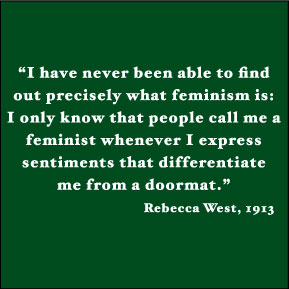
I remember in my first composition class in college, the word “feminism” came up and despite being a class predominantly filled with young women there was a hesitancy to identify oneself as a feminist. The instructor/ graduate TA was a PhD student of American studies, and she suggested we define feminism. The typical definitions arose along with some laughter regarding bra burning. It’s interesting how something which seems to have sprung from a desire to empower what was perceived as the weaker sex, is often regarded as a dirty word in contemporary circles. Why is the power behind this word so problematic? The general wave of definitions seemed to come from the vein of man hating, or that this was a collective group that not only valued their sex, but saw it as superior. Still on a fundamental level the argument for equality was reduced to the stereotype of an aggressive woman demanding something for herself.


At the time my instructor suggested we consider the term to mean “female pride.” And she wondered how that might change our conversation. Is it that simple though? Is it simply female pride? I think about “pride” with regard to gay pride weekend in Seattle. Admittedly Seattle is a large city with a significant gay population, and yet it’s hard not to see the population as empowered when they’re practicing/ demonstrating their culture in the form of a parade. So why all the fear? What specifically is to be feared if a person self-identifies as a feminist? Or with a group that is perceived to be on the peripheral? Is it a fear of any group with the power to transform our current state of society? I wonder if this fear also stems from the question of responsibility. There’s often a careful handling of material wherein oneself is a participant. The reality is we all partake in a form of oppression, suppression and repression with regard to a person’s sex whether we’re consciously aware of this role or not. So when an individual is able to articulate their victimization and ask for equality, perhaps it is a defense mechanism or for the sake of self preservation that they reject it. I think this is one reason why feminism is a useful angle when reading a text. The reader is asked to question the narration, the roles of female characters and the stereotypes that exist, and also to evaluate the attitude of other characters in relation to the female character. Naturally when evaluating this, there’s a distancing because thinking about these voices offers the reader a chance to look through the window and hopefully not implicate themselves. Instead they can review the oppression through the lens of a fictionally dominant group. Certainly, we are better able to understand ourselves, our impressions of the text reflect back who we are as readers, but there’s less an opportunity to feel victimized by the victimized.

In which I make a futile attempt to understand Bressler's tidy distinction between Structuralism and Poststructuralism


            As I read through Bressler's chapter on deconstruction and structuralism there were two quotes in particular that I felt dredged up some interesting issues for me. First, Bressler writes that "[a]lthough the voices of other poststructural theories, such as Cultural Poetics and Postcolonialism, are now strongly being heard and advocated, deconstruction's philosophical assumptions and practical reading strategies form the basis of many postmodern literary practices" (119).  Second he writes that one of the major critiques of structuralism is that "[i]n highlighting the various system of meaning, structuralism deemphasizes personhood and individual texts. Critics argue that structuralism is thus deterministic (favoring systems over events or an individual) and ahistorical...nor does it address for dynamic aspects of cultures" (121). What I am noticing, though is that it doesn’t really seem to be that clear. Particularly, I think that cultural poetics and postcolonialism do spend a lot of time working with systems and metanarratives, even if those metanarratives are ones of the previously (or continually) dispossessed populations, fringe cultures, etc.
            I think what is interesting about the model that Bressler is setting up throughout the chapter (and it seems to be a trend throughout the book) is one that delineates cultural poetics and structuralist theory as overtly focused on system (observable, recurring trends in narrative or language, etc) and thus lacking a nuanced understanding of reality. Meanwhile, post-structural theory is delineated by its focus on a subject-centric, contextually or relatively defined understanding of reality and literature. This model seems to be laid out in a clear fashion in the two quotes above. However, I think that there are some areas of overlap that Bressler fails to mention, particularly in reference to the question of subject-centeredness.
            Foucault is an interesting fringe case to look at to try to question some of the statements that Bressler is making here. If the major distinction between structuralism and poststructuralism is in subject-centeredness (or a lack thereof) Foucault seems to lie somewhere in between. Bressler’s model doesn’t seem to account for someone like Foucault, since he seems to be pretty intent on developing a binary understanding of structuralism and poststructuralism. I don’t wish to identify this case for the sake of highlighting a gaffe on Bressler’s part – rather, I think that looking at someone who straddles the line between structuralist and poststructuralist theory might help to better understand either one.
            A good way of starting to talk about Foucault and the system/subject binary is to identify him as not interested in one or the other, but rather someone who looks closely at the vertex of the subject and socio-political systems. Consider the concept of the episteme – for the most part, the episteme focuses much more on the system than the subject. Within the social and cultural boundaries that are erected, the subject has significant freedom, autonomy, and agency, but in the end it comes back to the way that power is leveraged over subjects and how those subjects exist within the system. The same might be said for Althusser and the Ideological State Apparatus. In both Althusser and Foucault emphasis is placed on a rather structuralist point concerning individuals and their interaction with the social and cultural systems they exist within. What matters is not the subjective experience of the individual, but rather the way that the complex of discourses that the subject perceives as reality “speaks through” the subject. An utterance or action in either model (say, obeying traffic laws), is neither the subject’s own or the system’s – it is a collaborative composition of the cultural forces that the individual is subject as much as it is his or her own thoughts.
            What is the difference between what Foucault or Althusser is doing and what cultural poetics and postcolonialism are trying to do? I think that cultural poetics and postcolonialism are both interested in systems – even if those systems are ones that indicate an instability in hegemony, and are distinct from deconstruction’s insistence that objective meaning is impossible. While they aren’t necessarily constructing and condoning metanarratives they are interested in systems. Maybe it comes back to the way that systems are defined in the second quote I introduced. A focus on systems is considered parallel to being unable to adress “dynamic aspects of cultures”. Those don’t seem to be mutually exclusive. They obviously inject more of the subject into the discussion than Bressler’s description of structuralism suggests. It doesn’t seem that they fit neatly into either category. Obviously Bressler thinks that they are more than just derivatives of structuralism and poststructuralism (otherwise he wouldn’t have given them their own chapters), but why does he decide to treat them as such in this chapter? Maybe what I’m identifying is not so much a local problem just for cultural poetics and poststructuralism -- perhaps this is aligned with Bressler’s section on critiques of deconstruction: “deconstruction is itself essentially establishing a metanarrative, one based on incredulity and doubt” (122).

Ecofeminism and The Tough Crowd of 213x


Caitlin Scarano
ENGL 601
Heyne
1 April 2012

Reading Response 3: Feminism

            As you may now know, reader, I’ve been teaching my ENG 213x course on various forms of nature writing – the class theme is “Writing and Imagining the Environment.”  In the course, we spent some time generally dealing with nature writing and the big names to know (Thoreau, Wendell Berry, Barry Lopez, etc), and then I taught a section on writing that regards our specific environment – Alaska.  Students at UAF, I’ve found, love talking about Alaska and how Alaskans are othered by the Lower 48. 
            This all relates to feminism in two relevant ways:
1.)   I want to teach them about ecofeminism, but for some reason I don’t feel knowledgeable or prepared enough.
2.)   I believe that I teach from a feminist pedagogical perspective, but until this week, I hadn’t realized how underrepresented women authors are in my course readings.
Now, before I get into #2, let’s revisit #1.  Ecofeminism is defined as “a contemporary approach in feminist studies that assumes that patriarchal societies are relatively new and that society’s original condition, known as Feminist Eden, was matriarchal.  Whereas patriarchal societies, say ecofeminists, are detrimental to women, children, and nature, matriarchal societies protect the environment, natural resources, and animal life while caring for women and children” (Bressler 340).  Sorry, this may be a clunky definition on ecofeminism, but I am trying to utilize our fine textbook.  Bressler, I’m guessing, may not identify as an ecofeminist, but he gives you the main points.
 I believe that ecofeminism founds itself on the following claim: the system that oppresses women is the same system that oppresses the environment – patriarchy.  The idea is that women are more connected to nature than men, because women are more empathetic to the condition of nature, and the possible exploitation done by men.  If we deconstruct the damaging components of patriarchy then the oppression and damage done to both women and the environment will decrease. At least, this is my interpretation.
But how to best teach the concept of ecofeminsim to a classroom of (seemingly mainly male, mainly while, mainly conservative) students who have probably never heard the term?  I want to give the students at least a brief introduction to ecocriticism, ecofeminsim, and ecopoetry – I feel this is my responsibility as an instructor, to at least expose my students to new and challenging concepts.  But the Alaska nature writing unit has been so successful, I am not sure if I want to switch it up this late in the semester.  So this reading response is my brainstorming process, I suppose.
I am still thinking about how to handle this, but in the mean time I am looking for good ecofeminist authors and texts that I might use (if you know of any, please share!).  A helpful introductory article could be “Ecofeminisms in Process” by Richard T. Twine, which has an academic-based focus on debates, theories, and potentially problematic or outdated ideals of ecofeminism: “The argument that ‘women’ are ‘closer to nature’ and ‘more embodied’ than ‘men’ is premised upon the problematic notion that (some of) humanity is separate rather than situated within nature, and attempts to subvert this mastering narrative by reproducing it are inevitably problematic” (Twine 3).   This specific quote highlights the issue of separating humanity (whether looking at the male or female gender) from nature.  My students and I have discussed this issue at length, especially considering the main points of William Cronon’s “Trouble with Wilderness.”  I could use this text or others like it to connect the topic of ecofeminism to our already ongoing class discussions.
Out of the thirteen authors we’ve read in my ENGL 213x course, four are women (Annie Dillard, Annie Tupek, Sherry Simpson, and Susan Kollin). I think I will soon teach Rachel Carson’s Silent Spring, or at least some of it.   I want to represent more women writers in the few short weeks that I have left in the course.  Fundamentally, if I am representing the environment mainly from the perspectives of male writers, I feeding into part of the problem that ecofeminism points out – that men define and dominate what is around them (in writing and other means). 


Sunday, April 1, 2012

Deconstruction in Samuel Beckett's Watt

"The result of this was that Watt never knew how he got into Mr. Knott's house. He knew that he got in by the back door, but he was never to know, never, never to know how the backdoor came to be opened. And if the backdoor had never been opened, but had remained shut, then who knows Watt had never got into Mr. Knott's house as all, but turned away, and returned to the station, and caught the first train back to town. Unless he had got in through a window" (Beckett 37).

This passage comes after two laborious paragraphs contemplating how the back door (locked when Watt first tried to enter, but then unlocked when he tried a second time, after finding the front door locked) could have either been unlocked the whole time or potentially unlocked by someone between checking the two doors.

I bring up this passage because I think it demonstrates, on a small scale, some of the ideas of deconstruction. Having endlessly meditated on how the door could have opened for him, Beckett sets up a binary situation (Enter Mr. Knott's house through the door/Go back) and then, with one final sentence, dispels the binary opposition entirely, making Watt's contemplation of the door seem almost entirely meaningless. Watt's contemplation of the door seems central to some grander scheme of ideas: he had to have gotten in somehow or would have been barred. A door left unlocked carries just as much metaphorical weight as a door stealthily unlocked between tries. The narrator plays along with this idea, implying that one of the central pillars of the story--Watt's arrival at Mr. Knott's house--might have been forgone entirely and a new set of events would have resulted. Instead, with one passive, fragmented sentence, the reader is opened to a humorously obvious third (among countless many) options.

As for the specifics of language, there are numerous instances where he seems either to directly or indirectly play with the subjectivity of language. Sometimes, it is at the expense of the reader: "Before leaving he made the following short statement" (39). This is how he opens what ends up being a 20-page rant by Arsene, the head servant who is leaving as Watt arrives. (For a brief (perhaps phonocentric) sample, about 1 1/2-2 pages somewhere in the first half, I've found a really good dramatic reading excerpt). The point being is that he is playing with the very subjective nature of a word like "short." In the very context of Arsene's rambling in that excerpt, it's clearly much shorter than the passage of time he describes and yet there is an expectation by many readers than when they read "short" it will presumably be far less than what they are given.
Throughout his speech (indicated by the last few lines of the video) he is constantly attempting to get back on track with constant asides of "now where was I?" and "but that's another matter." Yet his nebulous speech becomes a kind of act unto itself. He constant asks if he is being clear or if Watt "understands what he means." There is a kind of uncertainty that comes with articulating himself:
"Where was I? The change. In what did it consist? It is hard to say. Something slipped. There I was, warm and bright, smoking my tobacco-pipe, watching the warm bright wall, when suddenly somewhere some little thing slipped, some little tiny thing. Gliss — iss — iss — STOP! I trust that I make myself clear" (42-43).

There seems, on Arsene's part, a failure to find a word to describe himself, but presumes Watt can intuit his meaning.